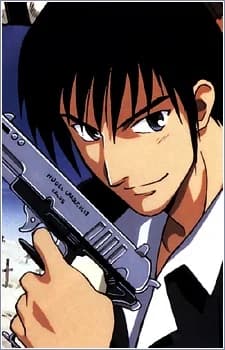
Wolfwood, Nicholas D.
Seiyuu / Dub
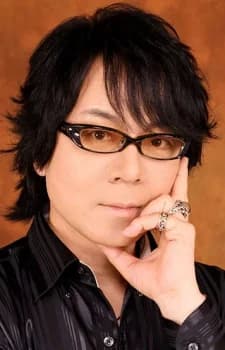 Hayami, Show· Japanese
 Hosoya, Yoshimasa· Japanese
 Kumagai, Mirei· Japanese
 Láng, Balázs· Japanese
 Roden, Simon T.· Japanese
 Torreão, Christiano· Japanese
 de Barros, Guilherme· Japanese
 Allende, David· Spanish
 De ambrosis, Massimo· Italian
 Hawkins, Brad· English
 Hidalgo, Carlos Hugo· SpanishKumagai, Mirei· English
Summary
After Vash’s bus accidentally runs over his motorcycle in the desert, Wolfwood becomes a crucial ally despite their clashing philosophies. While Wolfwood is a staunch believer in martialism, Vash adheres to pacifism, though Wolfwood eventually adopts Vash’s worldview by the series' end, even if it comes at a great personal cost. He primarily works to raise funds for the children in the orphanage he manages. He wields a massive cross that appears in two configurations. The first version features twelve pistols mounted along the cross's arms. The second version houses a giant machine gun in the vertical shaft and a rocket launcher at the top, with ammunition stored in the arms; some theories suggest one arm holds ammo for the machine gun and rocket launcher while the other contains six pistols. A skull symbol in the center serves as the trigger for the second version. The weapon is extremely heavy, a burden only Wolfwood, Milly, and Vash can handle without difficulty, although Vash has remarked on its weight. Although not named in the anime, the weapon is commonly called Punisher, a title derived from the manga. Wolfwood describes the weight as being "with God's mercy," a cynical remark fitting his character. Wolfwood is modeled after Tortoise Matsumoto, the lead singer of the Japanese rock band Ulfuls. His surname, Wolfwood, is a corruption of Ulfuls, which itself is a distortion of the English word soulful. Author Yukihiro Nakajo has given varying answers for the "D." in Wolfwood's name in interviews, ranging from "Dangerous" to a stereotypical yakuza phrase meaning "What family do you think I belong to? I will tie you up in a reed mat and sink you!" These expansions reflect the destructive force, anger, and violence that Nakajo intended for the character. In the original Japanese version, Wolfwood speaks in a Kansai Dialect, which Nakajo explains as an accent indicator within an English-speaking world setting.