Byulbyul Iyagi 2
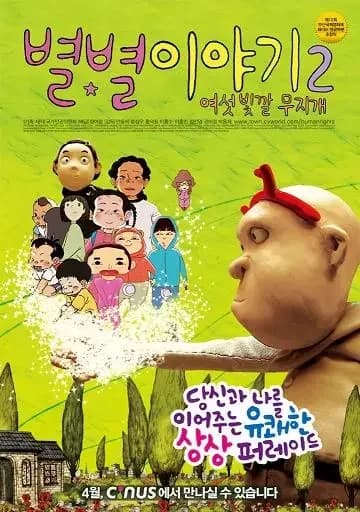
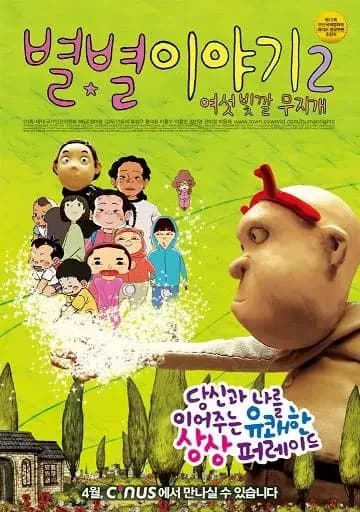
별별이야기 2: 여섯 빛깔 무지개
Synopsis
Continues the story of Byulbyul Iyagi
This anthology of six animated films explores subjects like discrimination and diversity. 1. "Daydream" looks at how society views people with disabilities, following a father and his daughter who has deformed hands and feet as they go through daily life. 2. "Animal Farm" uses a rough, unfinished stop-motion clay animation style to satirize bullying and the group psychology behind aggression. 3. "At Her House" delivers a pointed critique of gender inequality within marriage. 4. "Flesh and Bone" gently mocks the obsession with outward beauty and material possessions. 5. "Bicycle Trip" addresses the prejudice faced by foreign laborers in Korea. 6. "Be a Human Being" examines how young Koreans are dehumanized until they gain admission to a university.
In this installment
This film consists of six animated shorts produced by the Human Rights Commission of Korea. Like the previous movie, the stories explore seeing the world through the eyes of people who deviate from social norms. The film was nominated for Best Animated Feature at the 2008 Asia Pacific Screen Awards. 1. "The Third Wish” (AN Dong-hui, RYU Jeong-wu). A fairy godmother appears before a visually impaired young woman to grant her three wishes. But this is no fairytale. The irritable middle-aged fairy wants to finish her job as quickly as possible. Yet she proves helpful as she guides the woman through a busy marketplace, which is delightfully reminiscent of "Amelie." However, it's no easy walk, as busy urbanites show no consideration for our protagonist. Still, she overcomes obstacles. With a walking stick, she taps together the heels of her shiny new shoes and follows the "yellow brick road" (guiding tiles for the visually impaired) around the city. 2. "Ajukari” (HONG Deok-pyo) is a street-style cartoon. It comically depicts how a certain macho "complex" can cripple men. Male circumcision becomes the ultimate standard for being "manly," and those who have not undergone the procedure are forever fearful of going to public baths. 3. "Baby" (LEE Hong-su, LEE Hong-min) portrays the difficulties a career woman faces in having a child. "I'm not saying you can't take maternity leave, but can you afford to raise a child while working?" asks her boss. This clever story depicts everything from mother and daughter-in-law relationships to a parody of "Tazza: The High Rollers" and hilarious episodes where an "ambulance bus" picks up several patients along the way. 4. "Shine Shine Shining" (KWON Mi-jeong) is drawn like a warm, watercolor storybook for children. Grade schooler Eun-jin is smart and popular, but she has a secret. She hides her curly hair, which she gets from her Filipino mother, in braids. 5. "Merry Golasmas" is an adorable claymation, or stop motion animation of models constructed from clay, plasticine, etc. It explores physical discrimination or stereotypes. In an open audition to find a Santa Claus, the real Santas — one who's black, another who's Asian, a female Santa, and one in a wheelchair — lose to a fake Santa, a pot-bellied Caucasian. 6. "Lies" explores homosexuality. Drawn in pastel-like sketches with art deco-esque details, it is a stunning digital cut-out animation. A homosexual man is forced by his parents to marry a woman, while others are pressured to fake having a girlfriend or receive "therapy" to become straight.